// Practice · Support operations
Enablement
How I kept a growing support team's knowledge findable, current and usable, by people and later by an AI agent.
- My role
- Customer Success Manager, then the first enablement lead, then operations owner, at the same B2B SaaS company
- Team
- Grew from about 10 to about 50 while I was there
- Type
- Practice
- Confluence
- Intercom
- Jira
- Slack
- NotebookLM
- LearnUpon
- Atlassian Rovo
The approach
Answers were scattered across conversations, documents and people's memories, and every new hire started from scratch. My approach was the same in every role: put the answer where the next person will look, write down how it stays current, and make maintenance part of someone's job rather than a favour. Later, when an AI agent started answering from the same documents, that habit turned out to be the whole game: the agent is only as good as the page it reads.
The agent is only as good as the page it reads.
What I built
Internal knowledge base
Scattered internal FAQs consolidated into one Confluence knowledge base, with operating procedures and a knowledge-base update built into every new CSM's onboarding
Confluence
Customer help center
Organized the customer-facing articles; later maintained with the Support and web teams
Intercom
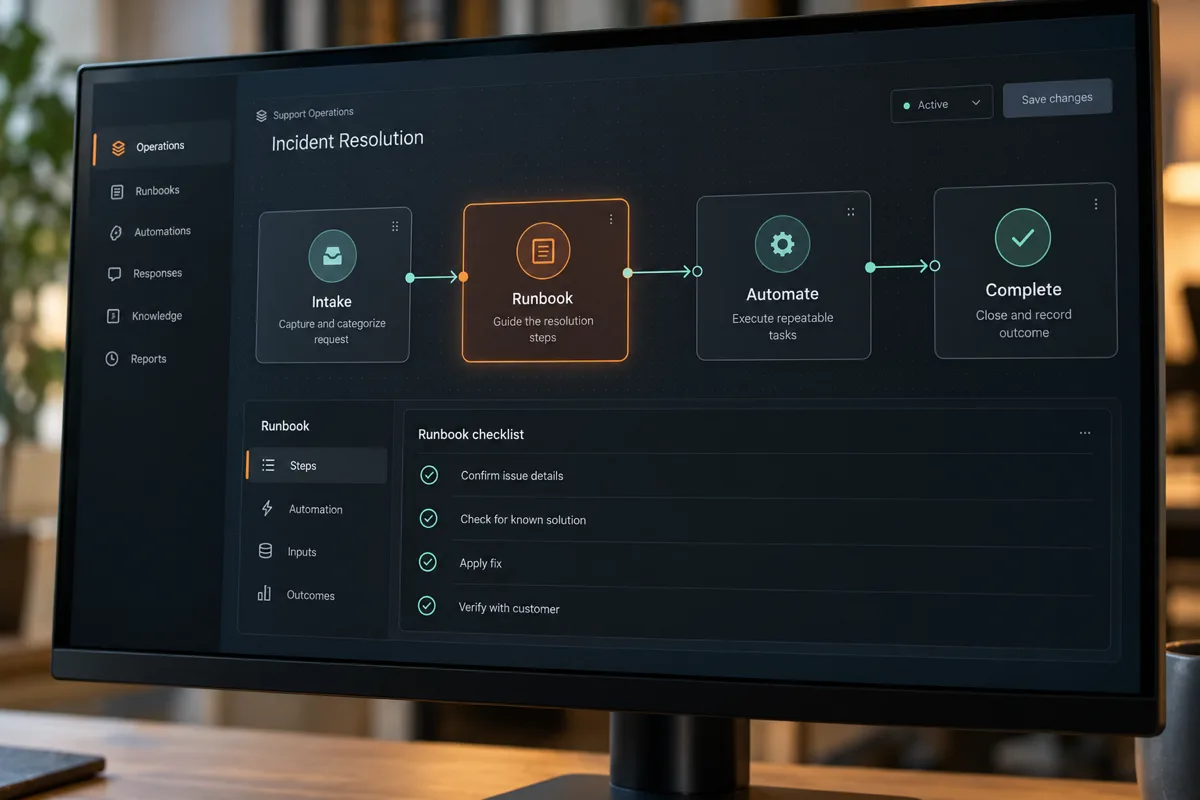
Integration-break runbook
When a client integration broke: reproduce, document, escalate with the research done, and stay the customer's single contact through resolution. Deep client-side builds belonged to the technical services manager
Jira, Confluence
Escalation paths
One route for critical product blockers between CS, Product and Engineering, with a feedback loop to Development and UX, across a distributed team
Jira
Enablement function
The company's first dedicated CS enablement: onboarding curricula, release documentation, playbooks, coaching and continuous training
Confluence, LMS
Learning management system
Part of the migration from WorkRamp to LearnUpon, then ran the LMS behind internal onboarding and customer certification, in partnership with the VP of Customer Success
LearnUpon
Technical runbooks and bug-reporting standards
Written for Support in the enablement years: how to reproduce, what to capture, when and where to escalate
Confluence, Jira
CS operations portal
One living document for every operations project, with a Jira intake board, a Slack support channel and a weekly call
Confluence, Jira, Slack
Tech-stack onboarding
One-on-one onboarding to the CS tools for new hires, including people outside CS
Intercom, Planhat, Jira
Knowledge notebooks
NotebookLM knowledge bases for several teams, on a standard instructions template, with scenario packs and a methodology page
NotebookLM
AI workshops
Hands-on sessions on prompting, call intelligence with NotebookLM and the vendor's MCP server
NotebookLM
Internal AI assistants
Two assistants, one grounded in the customer platform and company docs, one in the CS tech stack. Built and used by me and a couple of teammates; not rolled out org-wide
NotebookLM, Atlassian Rovo
The AI agent's knowledge corpus
The help center, developer docs and internal FAQ, audited page by page before an AI agent was allowed to answer from them
Intercom, Confluence
How it stays current
- Procedures with add, update and retire rules, so a page has an owner and an exit.
- A knowledge-base update as a learning task in every new junior CSM's onboarding. New people find the gaps; fixing one is how they learn the system.
- A weekly operations call, a Slack channel for questions, and a Jira intake board, so requests and fixes have one door.
- For the AI agent: every miss logged with a root cause (doc issue, agent issue, unclear), and the fix made on the source page, not in a prompt.
Where it paid off
- The same audited corpus later grounded the company's customer-facing AI agent, so fixing an article fixed the agent too. That work is the Fin case study.
- Account managers found answers faster with the knowledge notebooks, and used them for client dossiers during handoffs.
- Moving the LMS reduced software spend.
I do not have time-to-ramp, deflection or completion figures for any of this, so there are none here.